
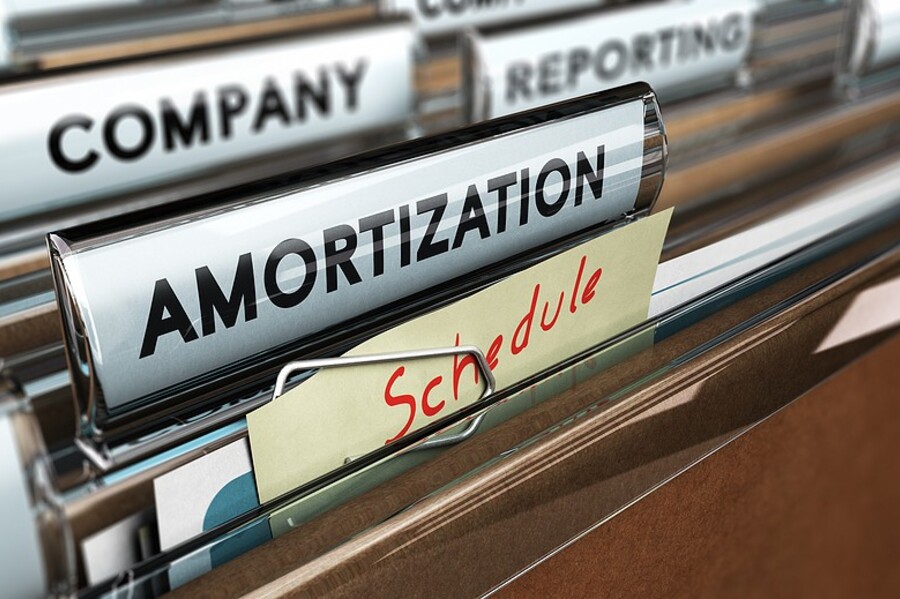
One of the many important tasks that a small business owner must manage is accounting. As Warren Buffett famously said, “You have to understand accounting, and you have to understand the nuances of accounting. It is the language of business.” Accounting is often referred to as the “language of business” because it provides a standardized way to measure, manage, and communicate a company’s financial health and performance. One of the key accounting and finance terms is amortization.
What is Amortization?
Amortization is a term that refers to two financial processes. First, the allocation and gradual write-down of an intangible asset’s cost over its expected use. Second, the scheduled reduction of a debt over a specified period through regularly scheduled payments.
- Intangible asset amortization. This is different from depreciation, which applies to tangible assets. Amortized expenses apply to intangible assets with a finite useful life. Intangible assets that can be amortized include patents, copyrights, trademarks, software developed for internal use, customer lists, licenses, and franchises.
- Loan amortization. This refers to the process of paying off debt, such as a loan or mortgage, in regular installments over time. Each payment includes a portion that goes toward the initial amount borrowed (principal) and a portion that pays for interest on the debt.
There are five methods used for amortization:
- Straight-line method. This is the most commonly used method. It allocates the total cost amount equally over the useful life of the asset or the term of the loan.
- Declining balance method. This method applies an amortization rate on the remaining book value of an asset each year of its useful life, or on the balance of the loan.
- Double declining balance (DDB) method. Using this method, the value of the asset, or the balance on the loan, is reduced twice as fast as the straight-line method.
- Bullet method. In the bullet method, the expense of the asset, or the cost of the loan, is recognized at once.
- Balloon payments. A balloon payment is the final oversized payment of the expense of an asset or a loan.
An Amortization Schedule
An amortization schedule is used to show how an expense or a loan is paid down over time. In the case of a loan, it details the total number of payments and the proportion of each that goes toward principal versus interest.
The Benefits of Amortization for Small Businesses
Amortization allows the cost of an asset to be spread over its useful life rather than taking a large expense in the year of acquisition. It allows businesses to deduct a portion of the asset’s cost each year as an expense, which can lower taxable income. By spreading out the cost of an asset or a loan, amortization can help a small business manage its cash flow more effectively. Amortization is a standard accounting practice that helps present a more accurate picture of a company’s health. While not a payroll accounting term, it is a critical element in a company’s financial management.
Choose an Expert Payroll Service
Choose Palmetto Payroll, an expert payroll service, to assist you with your payroll system. We have offices in Columbia and Charleston, serving over 300 business owners statewide. We offer tailored solutions to save you time and money so you can thrive and grow, including payroll, tax depositing and filing, management reporting, Human Resource Services, and timekeeping services.
